

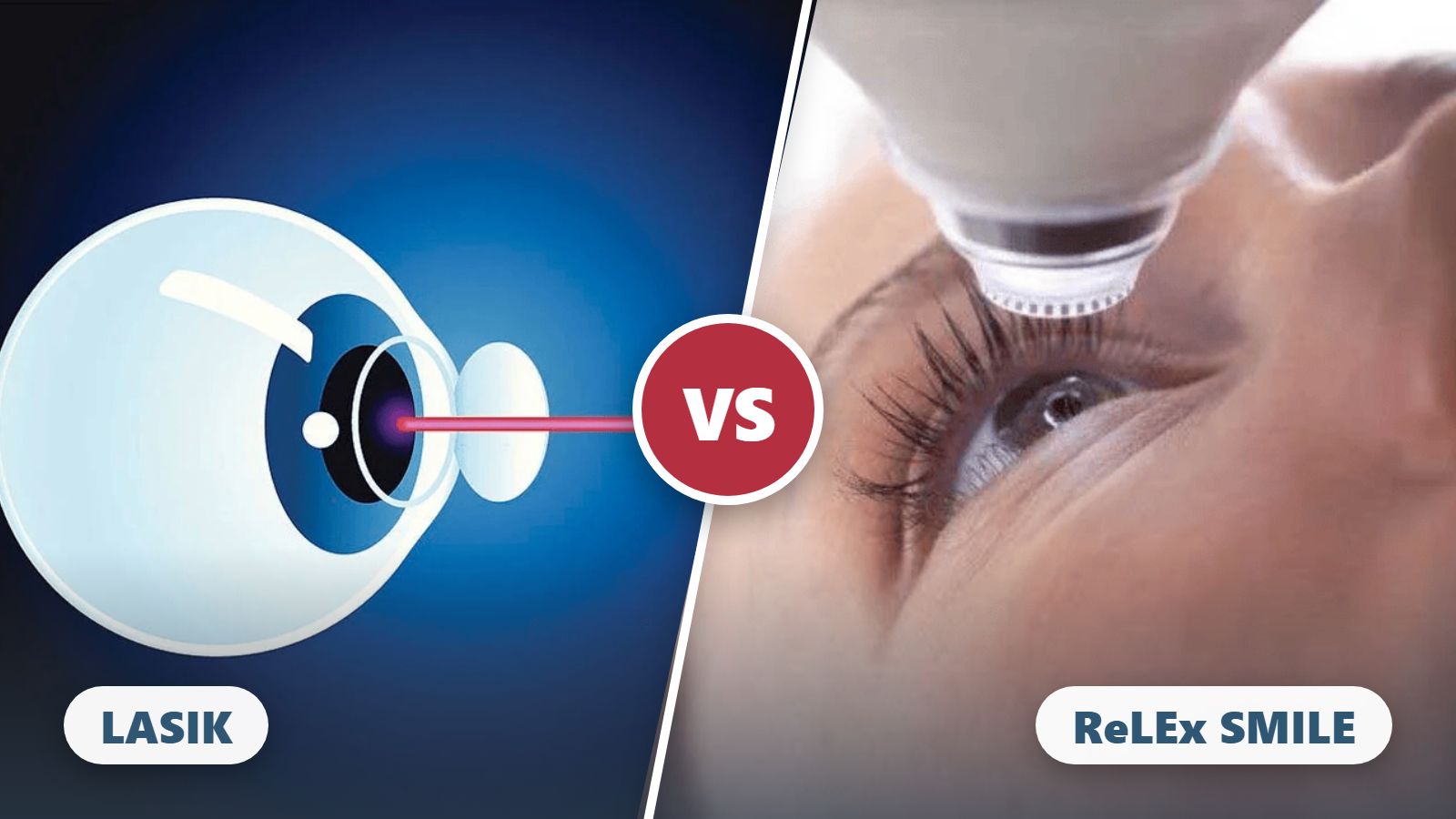
If you have worn glasses or contact lenses for years, you have probably come across two names for laser eye surgery: LASIK and ReLEx SMILE. Both reshape the cornea to correct vision, and both can give you freedom from spectacles. They get there in different ways.
This guide compares LASIK vs SMILE on procedure, recovery, suitability, dry-eye risk and cost, so you know what to ask before a consultation. If you are looking into LASIK eye surgery in Mumbai or ReLEx SMILE surgery in Mumbai, the right choice depends on your eyes, not on which name is newer.
The short answer: LASIK is the long-established option and can treat a wider range of prescriptions. SMILE is a newer, flapless option that suits many people with short-sightedness and may carry a lower risk of dry eye. Only a detailed eye examination can tell you which one fits you.
What Is LASIK and How Does It Work?
LASIK (laser in-situ keratomileusis) is one of the most widely performed elective surgeries in the world. It corrects short-sightedness, long-sightedness and astigmatism by reshaping the cornea, the clear front surface of the eye, so that light focuses correctly on the retina.
The procedure follows three steps:
- Flap creation: A thin, hinged flap is made in the surface of the cornea.
- Reshaping: The flap is lifted and an excimer laser removes a precise amount of corneal tissue, based on your prescription.
- Repositioning: The flap is laid back in place, where it heals naturally without stitches.
At Mehta International Eye Institute, LASIK is performed with the AMARIS laser from Schwind, and the institute offers several LASIK approaches, including Premium LASIK, Optimized LASIK and Ultimate Waveform LASIK. Which one suits you depends on factors such as your spectacle prescription, pupil size, corneal thickness, corneal curvature and higher-order aberrations. Technology matters, but the surgeon's skill and judgment matter just as much.
What Is ReLEx SMILE and How Does It Work?
ReLEx SMILE (Small Incision Lenticule Extraction) was developed by Carl Zeiss and uses the VisuMax femtosecond laser. It corrects short-sightedness and astigmatism without creating a corneal flap and without an excimer laser.
The procedure follows two steps:
- Lenticule creation: The femtosecond laser creates a thin, disc-shaped piece of tissue (a lenticule) inside the intact cornea, shaped to match your prescription.
- Removal: The laser makes a very small incision, and the surgeon gently removes the lenticule. The cornea settles into its new shape.
Because the surface of the cornea is left largely untouched, the technique is described as bladeless and flapless. Mehta International Eye Institute is equipped with the VisuMax system for ReLEx SMILE, and the institute states that the procedure takes about 12 minutes for both eyes.
LASIK vs SMILE at a Glance
The two procedures share the same goal but differ in technique, what they can treat and how they affect the cornea.
| Factor | LASIK | ReLEx SMILE |
|---|---|---|
| Technique | Thin corneal flap is lifted, then tissue is reshaped | Lenticule is formed inside the cornea and removed through a small incision |
| Corneal flap | Yes | No |
| Lasers used | Excimer laser, plus a femtosecond laser or blade to make the flap | Femtosecond laser only |
| Conditions treated | Short-sightedness, long-sightedness, astigmatism | Short-sightedness and astigmatism |
| Surgery time | A few minutes per eye | About 12 minutes for both eyes (institute figure) |
| Early recovery | Vision often improves within a day | Vision often improves within a day; sharpness may keep building over several days |
| Dry-eye risk | Higher, as the flap affects more corneal nerves | Lower, as more corneal nerves are preserved |
| Flap-related complications | Possible, though uncommon | Not applicable, as there is no flap |
| Cost | Usually lower for standard LASIK; advanced variants cost more | Usually higher than standard LASIK |
The sections below explain each row in plain terms.
SMILE vs LASIK Recovery: What to Expect
Both procedures are quick, and most people are back to routine life within a few days. The differences are small but worth knowing.
After LASIK
- Your eyes may feel scratchy or watery for the first few hours, and vision is blurred at first.
- Many people notice clearer vision the next day, and the surgeon reviews you soon after surgery.
- Because a flap was created, you will be advised to avoid rubbing your eyes and to protect them from impact while the flap heals.
After ReLEx SMILE
- Eyes stay light-sensitive and vision stays blurred for the first few hours, so you should not drive home yourself.
- According to the institute, most people can drive and start computer work within a day, with frequent breaks and regular use of the prescribed eye drops.
- Eye make-up can usually be resumed after about a week, once your doctor has cleared you.
- Rest on the day of surgery, and plan for a day or two off work.
In both cases, follow your surgeon's schedule for eye drops and follow-up visits. Recovery speed varies from person to person, so treat these timelines as a guide, not a promise.
Who Is Suitable for LASIK, and Who for SMILE?
Anyone considering laser eye surgery for glasses removal needs to meet some basic conditions first. Surgeons generally look for:
- Age of 18 or above, with a prescription that has stayed stable for at least a year
- Healthy eyes, with no active infection, inflammation or corneal disease
- Enough corneal thickness to be reshaped safely
- No keratoconus or other corneal weakness
- Good general health, and no pregnancy or breastfeeding at the time of surgery
LASIK may suit you if:
- You are long-sighted, as SMILE is mainly designed for short-sightedness and astigmatism
- Your prescription or corneal measurements fit LASIK better, as shown by your scans
- You want access to advanced LASIK options such as wavefront-guided treatment, where your eyes are suitable
SMILE may suit you if:
- You are short-sighted, with or without astigmatism
- You have mild dry eyes or spend long hours on screens or in air-conditioned rooms
- You play contact sports or have work or hobbies where a blow to the eye is a real risk, since there is no flap to dislodge
Neither may be right if your prescription is still changing, your corneas are very thin or irregular, or you have certain eye conditions. In those cases, your surgeon may suggest a different procedure.
One limit applies to both: after about age 40, natural focusing for near work declines (presbyopia), so you may still need reading glasses even after successful laser surgery.
Dry-Eye Risk and Cost: Two Factors That Often Decide the Choice
Dry-eye risk
Dry eye is one of the most common side effects of any laser vision correction. The cornea is rich in nerves that help trigger tear production, and surgery temporarily disturbs some of them.
LASIK involves a corneal flap, which cuts across more of these nerves. SMILE works through a much smaller opening and preserves more of them, which is why studies, and the institute's own patient information, point to a lower chance of dry eye after SMILE. In both cases dry eye is usually temporary and managed with lubricating drops, but if you already have dry eyes, tell your surgeon early.
Cost factors
There is no single price for either procedure. The final cost depends on:
- Procedure and technology: SMILE is generally priced higher than standard LASIK, while advanced LASIK options such as wavefront-guided treatment cost more than a standard LASIK procedure.
- Your prescription and eye scans: Complex cases can need more planning.
- Surgeon and centre: Experience, equipment and accreditation affect pricing.
- Pre-surgery tests and follow-up: Check whether the quote includes your detailed evaluation, medicines and review visits.
Ask for a written, itemised estimate after your examination, and compare what each quote includes. The lowest price is not always the best value when it comes to your eyes.
Frequently Asked Questions
Which is better, LASIK or SMILE?
Neither is better for everyone. LASIK is more established and treats a wider range of prescriptions. SMILE is flapless and may be gentler on the corneal nerves. The better choice is the one your eye scans and prescription support.
Is the result of laser eye surgery permanent?
Both procedures reshape the cornea permanently, so the correction does not wear off. Your eyes can still change with age, and presbyopia (the need for reading glasses after about 40) is unrelated to the surgery.
Is the surgery painful?
Both are quick, and numbing drops are used. Most people feel pressure or mild discomfort at most, and a gritty or watery feeling for a few hours afterwards.
Do I need to stop wearing contact lenses before surgery?
Yes. Your surgeon will ask you to stop wearing contact lenses for a period before your evaluation and surgery, because lenses can temporarily change the shape of the cornea. Follow the exact instructions you are given.
Can I have cataract surgery later in life?
Yes. Neither LASIK nor SMILE prevents later cataract surgery. Tell your cataract surgeon about your earlier laser treatment so the lens power can be calculated correctly.
How long does it take to recover after SMILE vs LASIK?
Most people return to routine activities within a few days after either procedure. See the recovery section above for a detailed comparison.
Book Your LASIK or SMILE Suitability Check-Up in Mumbai
LASIK and SMILE are both proven ways to reduce or remove your dependence on glasses. The real question is which one is safer and more effective for your eyes, and that cannot be answered from a blog post. It takes a detailed examination that includes corneal thickness, corneal shape, pupil size, prescription stability and the health of your tear film.
At Mehta International Eye Institute, a NABH-certified eye hospital in Colaba, Mumbai, you can learn more about LASIK and ReLEx SMILE and have your eyes assessed by Prof. (Dr.) Keiki R. Mehta's team. You will leave with a clear recommendation, an explanation of the alternatives, and an estimate you can plan around.
Book your suitability check-up today:
- Online: Make an appointment
- Phone: 022 2215 1303 or +91 91371 88334
- WhatsApp: +91 98200 21041
- Visit: Sea Side Building, 147, Shahid Bhagat Singh Road, Near Colaba Bus Station, Colaba, Mumbai 400005
- Hours: Monday to Saturday, 10 AM to 9 PM (Sunday closed)
This article is for general information and is not a substitute for a medical examination. Suitability and results vary from person to person.